Home / Pest cities research / Termite cities
2026 edition · City rankings & homeowner guide
The Top 50 Most Termite-Infested Cities in America
Find your city. Understand the ranking. Learn which signs deserve a closer look at your home.

A termite ranking can tell you where a company treated the most homes. It cannot tell you whether the wood behind your walls is being damaged. This guide pairs the published city list with practical ways to interpret evidence, compare treatment proposals, and ask better inspection questions.
The complete list
Find your city in the top 50
Search by city or state. The rank stays exactly as published; filtering does not create a new ranking. A city missing from this list can still have termites.
Showing all 50 ranked markets.
| Rank | City / market | State |
|---|---|---|
| 1 | Miami | FL |
| 2 | Los Angeles | CA |
| 3 | Tampa | FL |
| 4 | Washington, D.C. | DC |
| 5 | Orlando | FL |
| 6 | Houston | TX |
| 7 | West Palm Beach | FL |
| 8 | Dallas | TX |
| 9 | New York | NY |
| 10 | Atlanta | GA |
| 11 | Baltimore | MD |
| 12 | San Diego | CA |
| 13 | Philadelphia | PA |
| 14 | Chicago | IL |
| 15 | San Francisco | CA |
| 16 | New Orleans | LA |
| 17 | Greenville | NC |
| 18 | Charlotte | NC |
| 19 | Phoenix | AZ |
| 20 | Raleigh | NC |
| 21 | Charleston | SC |
| 22 | San Antonio | TX |
| 23 | Nashville | TN |
| 24 | Knoxville | TN |
| 25 | Memphis | TN |
| 26 | Honolulu | HI |
| 27 | Fort Myers | FL |
| 28 | Charleston | WV |
| 29 | Pittsburgh | PA |
| 30 | Oklahoma City | OK |
| 31 | Indianapolis | IN |
| 32 | Cincinnati | OH |
| 33 | St. Louis | MO |
| 34 | Harrisburg | PA |
| 35 | Kansas City | MO |
| 36 | Richmond | VA |
| 37 | Norfolk | VA |
| 38 | Waco | TX |
| 39 | Austin | TX |
| 40 | Jacksonville | FL |
| 41 | Savannah | GA |
| 42 | Columbia | SC |
| 43 | Grand Rapids | MI |
| 44 | Lexington | KY |
| 45 | Harlingen | TX |
| 46 | Chattanooga | TN |
| 47 | Wichita | KS |
| 48 | Champaign | IL |
| 49 | Detroit | MI |
| 50 | Mobile | AL |
No matching cities. Try another spelling or clear the state filter. An unlisted city is not necessarily low-risk.
Source: Orkin’s 2026 Top 50 Termite Cities (opens in a new tab). State labels are added for navigation. These are source-published market labels, not standardized municipal boundaries.
Bro’s analysis of the published list
What the state comparison reveals
States with the most listed markets
Count of entries, not statewide infestation rates
Bro’s Pest Control calculations from the 50 ranked entries. Six states account for 25 of the 50 entries.
The list includes inland, coastal, northern, and southern markets. That is a useful reminder to base a property decision on local species, construction, moisture conditions, and inspection findings—not on a city’s reputation alone.
These counts describe the composition of this particular company’s list. They are not adjusted for population, housing stock, or the company’s customer footprint.
Look for evidence, not just a ranking
Termite warning signs worth investigating
Swarmers indoors
Insects emerging from a wall or large numbers of winged termites indoors warrant an inspection. A few insects attracted from outside do not always prove a structural infestation.
Mud shelter tubes
Earthen tubes on a foundation or in a crawl space deserve professional assessment, even when you do not immediately see live termites.
Damage inside wood
Damage may be hidden. Old galleries do not, by themselves, establish current activity. Ask an inspector to distinguish historic damage from evidence of a live infestation.
Evidence and context: Mississippi State University Extension’s warning-sign guide (opens in a new tab).
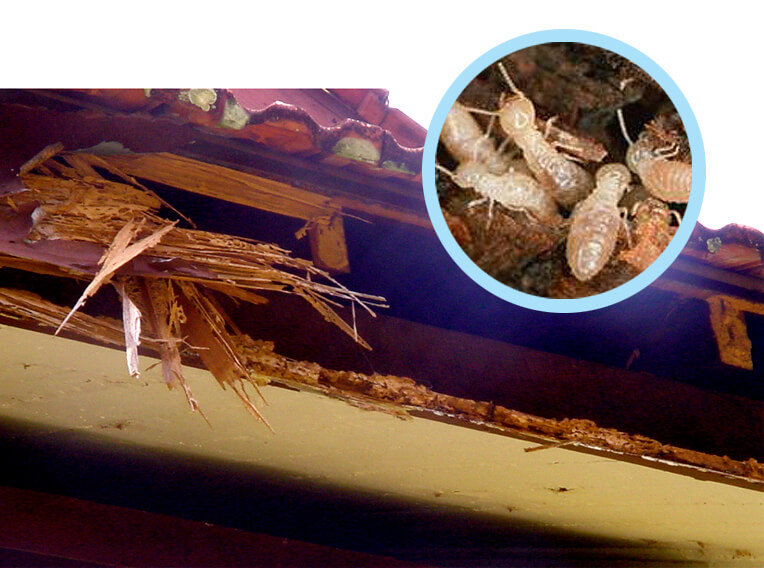
If you find suspicious evidence: photograph the location, note the date, save an insect sample if practical, and arrange identification. Ask the inspector to show you the evidence supporting any recommended work. Spraying visible swarmers alone does not address the colony that produced them.
Identification changes the solution
Not all termites need the same treatment
On smaller screens, swipe comparison tables sideways to see every column.
| Group | Where they live | Why identification matters |
|---|---|---|
| Subterranean | Usually associated with soil and moisture; may reach wood through shelter tubes. | A plan must address how the colony accesses the structure. |
| Drywood | Live inside relatively dry wood and do not require a connection to the soil. | Localized work and whole-structure treatment have different coverage. |
| Dampwood | Associated with very moist wood. | Finding and correcting the moisture source is central to the response. |
Biology and management context: UC IPM: subterranean and other termites (opens in a new tab) and UC IPM: drywood termites (opens in a new tab). These California resources explain termite biology; the city list does not identify which species were treated in each market.
Winged termite or flying ant?
Compare more than one feature. Photos and specimens can help an extension specialist or pest professional confirm the identification.
| Feature | Winged termite | Winged ant |
|---|---|---|
| Waist | Broad | Pinched |
| Antennae | Straight | Elbowed |
| Wing pairs | Similar length | Front pair longer |
University of Maryland Extension: ants versus termites (opens in a new tab).
Understand the proposal
How termite treatment options differ
An inspection should come before a treatment recommendation. Ask which termite group is involved, which areas are accessible, and why the proposed method fits the evidence.
| Approach | What to understand | Ask the provider |
|---|---|---|
| Soil-applied treatment | Labeled termiticides can create a treated zone around or beneath a structure. | Where will the product be applied, and what preparation is required? |
| Bait system | Uses slow-acting insecticide in cellulose bait; inspection and monitoring are part of the program. | How often are stations checked, and what ongoing service is included? |
| Localized drywood treatment | Targets a limited area; concealed or undetected infestations may remain outside its reach. | How did you determine the extent, and what happens if activity appears elsewhere? |
| Whole-structure drywood treatment | Options can include professional fumigation or heat, with different preparation and limitations. | What must occupants remove, when can they return, and what follow-up is included? |
Treatment background: EPA termite guidance (opens in a new tab) and UC IPM’s drywood treatment comparison (opens in a new tab). This is an overview for discussing a proposal, not pesticide application instructions.


Bring these questions to an inspection
- Can you show me the insects, damage, or other evidence you found?
- Which termite group is involved, and is activity current or uncertain?
- Which areas could you not inspect?
- Why do you recommend this treatment over the alternatives?
- Does the written price include monitoring, follow-up visits, and any repairs?
- What does the warranty cover, exclude, or require me to renew?
Keep the inspection report, treatment plan, product information, and agreement together. Those records make future findings and competing proposals easier to compare.
A practical home check
Reduce conditions that invite termites
- Repair leaks and address persistent moisture.
- Maintain gutters, downspouts, and drainage near the foundation.
- Keep firewood and wood debris away from the house.
- Keep vents clear and reduce avoidable access openings.
- Inspect periodically and keep prior treatment records.
- Have suspicious insects or damage identified before buying treatment.
Prevention guidance: EPA: preventing termite infestation (opens in a new tab). The right inspection schedule depends on the property, local conditions, and any existing service agreement.
Skip the one-size-fits-all spray. Killing insects on contact is different from protecting a structure or treating a concealed colony. Verify the provider’s license and ask for the product label and preparation instructions. Follow the applicable label and reentry directions.
EPA: choosing and understanding termite treatment (opens in a new tab).
Source transparency
How this report was assembled
The ranking uses Orkin’s residential termite treatments in owner-occupied homes from January 15, 2025, through January 16, 2026. Source report (opens in a new tab).
Bro’s preserved the published order, added state labels for navigation, and counted entries by state. The CSV contains the same 50 rows, report year, and source URL. No cities were added or removed, and no weighted risk score was created.
- Company activity is not nationwide prevalence. Customer coverage, market size, and service demand can affect treatment volume.
- There is no household denominator here. The list cannot establish the chance that a particular home is infested.
- Markets are not standardized boundaries. Do not compare these labels as though they were identical geographic survey units.
- 2026 is the release year. The underlying observation period includes 2025 and is not a full 2026 calendar-year count.
- The ranking does not specify species or severity. It cannot tell you which treatment a particular property needs.
Bro’s Pest Control is a referral resource. The city ranking is not based on Bro’s referral volume, inspections, or customer records. Homeowner guidance is separately sourced to EPA and university extension publications.
For a comparison across different pests, see our 2026 pest-infested cities report.
Frequently asked questions
What homeowners ask about termite cities
What city has the most termites in 2026?
Miami is first in the cited company treatment ranking. That does not establish that it has the highest termite population or household infestation rate across all U.S. cities.
Is my home safe if my city is not on the list?
A missing city is not proof of low risk. Use local guidance and a property inspection when insects, damage, moisture, or treatment history raise concerns.
Does a swarm mean my house is infested?
Not always. Insects emerging from the structure are different from a few insects attracted from outside. Location, species, and the amount of evidence matter. An inspection can clarify the situation.
Does every termite problem need tenting?
No single method fits every termite group. Whole-structure fumigation is one drywood option; subterranean management commonly involves approaches that address access from soil. Ask why the proposed method fits the findings.
How much will termite treatment cost?
This ranking contains no pricing data. Request a written, property-specific proposal that separates initial treatment, monitoring, renewals, repairs, and warranty terms.
Is there one termite swarm season across the country?
Timing varies by species and place. UC IPM describes different swarming patterns for subterranean and drywood termites in California; use local extension advice rather than a nationwide calendar.
Can I cite or download the city list?
Use the CSV download above. Credit Orkin for the original ranking and Bro’s Pest Control for the state-count analysis and explanatory guide. Keep the observation dates and treatment-volume limitation with the citation.
References
Check the original guidance.
External reference links open in a new tab.
- Orkin: 2026 Top 50 Termite Cities (opens in a new tab) — ranking source, released February 17, 2026.
- EPA: Termites—How to Identify and Control Them (opens in a new tab) — prevention, treatment, and provider selection.
- Mississippi State University Extension: Signs of Termite Infestation (opens in a new tab) — warning signs and interpretation.
- UC IPM: Subterranean and Other Termites (opens in a new tab) — biology and management context.
- UC IPM: Drywood Termites (opens in a new tab) — detection and treatment coverage.
- University of Maryland Extension: Ants and Termites (opens in a new tab) — identifying winged insects.
Suggested citation: Bro’s Pest Control. “The Top 50 Most Termite-Infested Cities in America: 2026 Edition.” State-count analysis of Orkin’s 2026 ranking, with homeowner guidance. Sources checked October 22, 2026.
Photos are illustrative images from the site’s existing media library. They do not document infestations or treatment at the ranked cities.
Get help with the evidence at your property
Find a local termite inspection provider.
Describe what you found and where service is needed. Bro’s can help connect you with an independent pest control company that may serve your area.
Request termite helpCall 1-888-497-9069Availability, inspection fees, treatment, and warranties vary by provider. Review the independent company’s proposal before hiring. How our referral service works.