
Need professional help?
Request springtail control.
Ask about an inspection, treatment options, and a quote for your home.
Bro’s connects you with independent providers. Confirm availability, inspection fees, and pricing with the provider.
National homeowner guide · Identify and solve the moisture problem
Tiny bugs jumping around the sink, shower, window sill or plant pot? Springtails are usually a moisture-related nuisance. Confirm what you found before choosing a treatment.
Remove the springtails you can see, then find and correct the damp conditions that support them. Leaks, condensation, wet plant soil and damp exterior materials are useful places to investigate. Repeated spraying without moisture correction is unlikely to provide lasting relief.
What do springtails look like?
Springtails are tiny, wingless arthropods. Many household types are around 1–2 millimeters long, but sizes and colors vary. Some have an elongated body; others are rounded. Many jump when disturbed using a forked structure tucked beneath the abdomen.


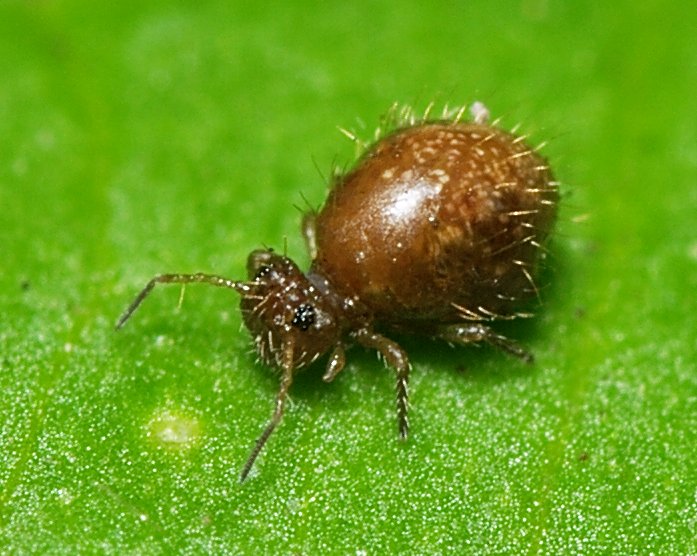

These enlarged photographs show examples, not every household species or an actual-size scale. Photograph your specimen next to a ruler and keep a wider image of the location. Do not identify a tiny bug from color or jumping alone.
| Clue | Springtail | Why it matters |
|---|---|---|
| Body | Wingless; elongated or globular, with antennae. | A flying insect needs a different identification. |
| Movement | Many can spring away when disturbed. | Fleas also jump; this feature is not enough alone. |
| Location | Often associated with damp places and organic material. | Record the conditions, not just the room name. |
University of Minnesota notes that fleas are flattened from side to side, while springtails have softer, more rounded bodies. If you cannot see those features, request identification rather than selecting a flea treatment by guesswork. Identification source: UMN Extension.
Springtails in the bathroom: are they coming from the drain?
A springtail in a tub or sink does not establish that it bred inside the drain. UC IPM explains that they can become trapped in smooth-sided fixtures while looking for moisture. Check the surrounding conditions before choosing drain treatments.
Check water and condensation
Look under accessible plumbing for drips, inspect the cabinet base, and note whether surfaces stay wet after normal use. Record condensation separately from an obvious leak.
Check nearby sources
Inspect plant saucers, damp mats and nearby window or door edges. Note the closest damp location even when the insects collect somewhere else.
Remove visible springtails by vacuuming or wiping them up. Never pour or spray insecticides down drains. For a persistent leak, the next useful visit may be from a plumber rather than another pesticide application. Source: UC IPM springtail guidance.
A moisture checklist for the rest of the home
Follow the route from the sighting to nearby water, soil and entry points. Start with accessible areas; do not open walls or enter a crawl space just to complete this checklist.
Inside
Outside
University of Maryland connects indoor springtails with dampness and notes that fixing leaks or drying affected areas often resolves the problem. UMN also recommends reviewing drainage and irrigation. The checkboxes are temporary and are not saved when you leave.
Maryland Extension: indoor moisture · UMN Extension: inspection and management
Springtails in houseplants: change the conditions carefully
Check whether soil stays excessively wet or water remains in a saucer. Adjust watering and drainage to suit the plant instead of applying the same drying schedule to every species. Do not leave standing drainage water beneath the pot.
UC IPM recommends avoiding overwatering and allowing soil to dry between waterings where appropriate. Springtails help break down organic material; their presence does not automatically mean a mature houseplant needs insecticide treatment.
Why springtails keep coming back
Penn State explains that both drought and prolonged saturating rain can push springtails out of outdoor habitats. Indoor persistence can also be supported by humid conditions. Use the pattern of sightings to choose what to investigate next.
| Pattern you observe | Next check |
|---|---|
| Activity after watering plants | Record which pot was watered and inspect its saucer and nearby surfaces. |
| Activity after rain or irrigation | Compare exterior damp areas and accessible entry gaps with indoor sightings. |
| Repeated activity in the same bathroom | Recheck leak repairs, condensation and how long surfaces stay damp. |
| Scattered insects but no damp source | Confirm identification before widening the treatment area. |
These are inspection prompts, not proof of a cause. Keep a short log: date → location → weather or watering → damp conditions → action → follow-up observation. Recheck the same spots so the notes are comparable.
When professional help is useful
Ask for identification when photographs are unclear, and for an inspection when numbers remain high after reasonable moisture corrections. Tell the provider what was repaired or changed and share your sighting log. Ask whether the proposed work addresses an entry route, an indoor moisture source, or both.
- Plumbing issue: ask who will locate and repair the leak.
- Persistent building dampness: ask whether a building or moisture specialist is needed.
- Pest service: request the identification, inspection findings, full price and follow-up plan.
Do not assume pesticide treatment includes plumbing or structural repairs. Confirm those responsibilities before hiring.
Request inspection help →Common springtail questions
Do springtails bite people or pets?
University Extension guidance states that springtails do not bite or sting. Do not identify an insect from a skin symptom; get a specimen or photograph checked.
Does finding them prove there is mold behind the wall?
No. They are a reason to check damp conditions, not a mold test or a diagnosis of concealed damage. Document what you can see and ask for an appropriate inspection if dampness persists.
Do I need to spray every room?
Indoor sprays are generally not recommended for springtails by the Extension sources linked here. Start with identification, removal and moisture correction rather than a whole-home application.
How fast should they disappear?
There is no single deadline for every home. Follow whether dampness and sightings are decreasing, and reassess the source if the problem persists.
Related identification guides
Finding hairy larvae around stored textiles? See carpet beetle larvae and shed skins. Finding insects inside dry food? Start with pantry pest identification.